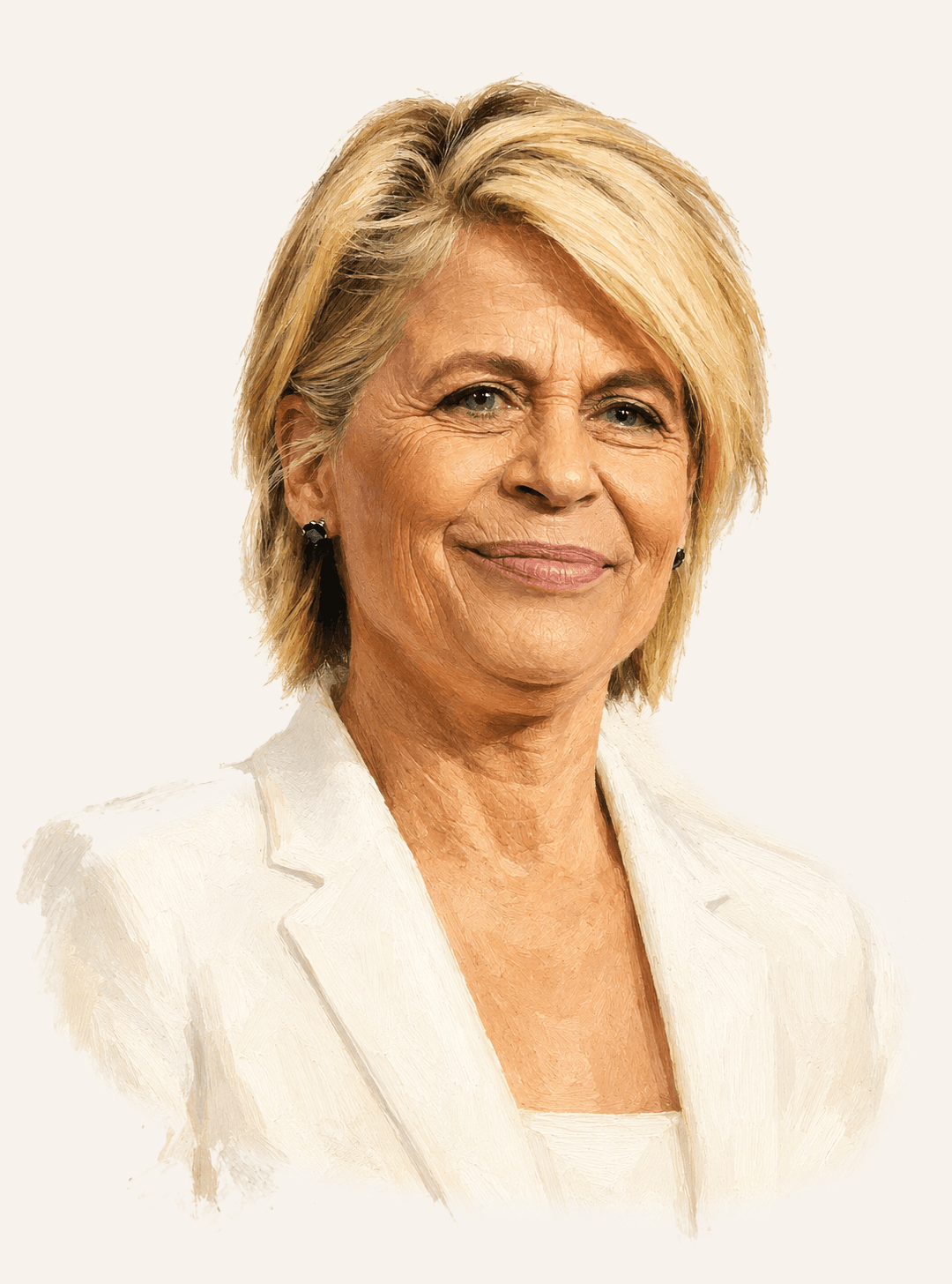
Linda Hamilton by Gage Skidmore.jpg
CC BY-SA 3.0
Painted adaptation; background changed to #f7f3ec by The Bipolar Biography Project.
Adaptation shared under the same license.
Full image attribution details
Linda Hamilton
ActorUnited States
Linda Hamilton is an American actor best known for portraying Sarah Connor in The Terminator and Terminator 2: Judgment Day, as well as Catherine Chandler in the television series Beauty and the Beast. Her work on Beauty and the Beast earned her an Emmy nomination and two Golden Globe nominations. [6][3]
Career and work
Hamilton began working in television in the late 1970s and early 1980s before gaining international recognition as Sarah Connor in James Cameron’s The Terminator in 1984. She returned to the role in Terminator 2: Judgment Day in 1991, a performance that became one of the defining roles of her career. [4]
On television, Hamilton starred as Catherine Chandler opposite Ron Perlman in Beauty and the Beast from 1987 to 1989. Her performance earned her an Emmy nomination and two Golden Globe nominations. She later continued working across film and television, including roles in Dante’s Peak, Chuck and Terminator: Dark Fate. [6][3][2]
What has been publicly discussed
- Hamilton has said she was diagnosed with bipolar disorder around age 40, after roughly two decades of severe mood symptoms. She had previously been diagnosed with depression, but later received a bipolar diagnosis that accounted for both the depressive and elevated sides of her experience. [1][5]
- She began discussing the diagnosis publicly in 2004. Hamilton said she chose to speak openly because treatment had dramatically changed her quality of life and she wanted to reduce the shame surrounding mental illness and encourage other people to seek help. [5]
- Hamilton has described severe mood swings involving periods of intense energy and confidence followed by profound depression. She said that during elevated periods she could feel extraordinarily capable and energized, while depressive periods could leave her unable to get off the couch or carry out basic tasks such as putting her children to bed. [1]
- She has also described periods of rage, anxiety, major sleep disruption and repetitive frightening thoughts. After the birth of her second child, Hamilton experienced a severe postpartum depression that she described as “very much like a psychosis,” including vivid fears and images of harm coming to her children. She has also said there were times when she did not want to be alive, although she did not intend to act on those thoughts. [1]
- Hamilton has said she spent about 20 years seeking help through therapy and other approaches before receiving the bipolar diagnosis and beginning medication that worked for her. She initially resisted medication because she feared it would diminish important parts of her personality and ability to act, but later said treatment gave her a degree of control she had not previously had. [1]
- She has deliberately avoided publicly naming the medication she takes, saying she does not think it is responsible to recommend a particular drug based on her own experience. Hamilton has also emphasized a broader approach to wellness that includes attending to both mental and physical health rather than relying on medication alone. [1]
- Hamilton has described treatment as allowing her to gain a sense of control after years of severe mood instability. In 2004, she said her quality of life had become better than she had imagined possible during the roughly 20 years she spent struggling with the illness before finding effective treatment. [5]
- She has been careful not to describe herself as cured. In a 2005 interview, Hamilton said she was “managing” her mental illness and expected to remain on medication for life. She also said she was continuing to improve over time, describing each year as “richer and richer” as she felt more like herself. [1]
- Hamilton has said that one of the main reasons she began speaking publicly about bipolar disorder was to reduce stigma and make it easier for people to seek help. In 2004, she said she wanted to be a “messenger of hope” and to “destigmatize the words mental illness” by showing that effective treatment can substantially improve quality of life. [5]
- She has also encouraged people to educate themselves about symptoms, speak openly about mental health and continue seeking professional help when they need it. In a 2005 interview, Hamilton urged parents in particular to start conversations with their children about mood and emotional wellbeing. [1]
“I’m getting better every year. I’m still getting better.”
— Linda Hamilton [1]
Sources and other resourcesExpand to view the sources used in this profile and resources to learn more.
Sources used for this profile
The following sources contain information that supports the claims made on this page.
CNNLarry King Live: Interview With Linda Hamilton Diagnosis, experiences, treatment, recovery and advocacy.
TV GuideLinda Hamilton biography Career.
Golden GlobesLinda Hamilton Golden Globe nominations.
View all 6 sources
Encyclopaedia BritannicaLinda Hamilton Career overview.
Pittsburgh Post-Gazette“Actress Linda Hamilton reveals disorder” Diagnosis, treatment and stigma.
Television Academy1989 Emmy nominees Emmy nomination for Beauty and the Beast.
Learn more
Recommended books and other resources about Linda Hamilton and their experiences.